
Glutamate receptors
Glutamate neurotransmission plays an important role in a number of physiologic and pathophysiologic processes. Activation of glutamate receptors occurs in pathways involved in pain, neurotoxicity and memory formation.
There are big expectations in the neuropharmacology field about the possible clinical applications of novel agents acting on these receptors. Some of the conditions that might benefit from future glutamatergic drugs include: hyperalgesia, stroke, epilepsy and schizophrenia.
This article overviews the structure and physiology of glutamate receptors.
Outline:
- Classification
Structure and characteristics
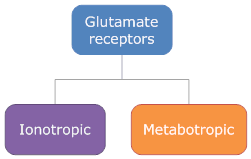
Glutamate receptors are divided into two subgroups: ionotropic (ligand-gated ion channels) and metabotropic (G protein-coupled receptors).
Ionotropic glutamate receptors

These receptors act as cation-selective channels, when activated they allow the flow of Na+ , K+ and Ca2+.
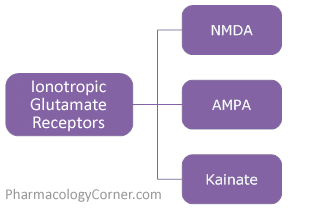
Ionotropic glutamate receptors can be subdivided into three subtypes, according to their activation by selective agonists such as NMDA, AMPA and kainate.
NMDA receptors
NMDA receptors are ligand-gated ion channels, with a primary glutamate-binding site and an allosteric glycine-binding site.These receptors consist of multisubunit oligomeric transmembrane complexes. NDMA receptor subunits include:
- NR1
- NR2A
- NR2B
- NR2C
- NR2D
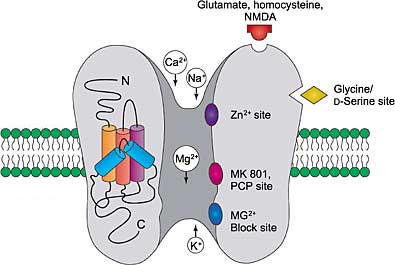
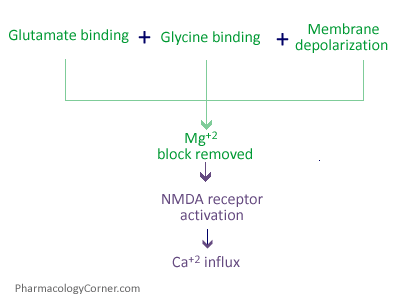
Three events need to occur simultaneously in order to activate NMDA receptors: binding of glutamate and glycine (which acts as cotransmitter) and membrane depolarization. Under resting conditions, Mg2+ ions block the channel pore in the resting membrane. When NMDA receptors are activated, Mg2+ ions are removed from their location, allowing the influx of Ca+2 ions.
AMPA receptors
AMPA (alpha-amino-3-hydroxy-5-methyl-4-isoxazole-propionic acid) receptors are constituted of four subunits:
- GluR1
- GluR2
- GluR3
- GluR4
These receptors regulate fast excitatory postsynaptic depolarization at glutamatergic synapses. AMPA receptors are located in the CNS, specially in the hippocampus and cerebral cortex.
Kainate receptors
Kainate receptors are expressed throughout the CNS, particularly in the hyppocampus and cerebellum where they play a role in both pre- and postsynaptic neurotransmission.
Five kainate receptor subunits have been identified:
- GluR5
- GluR6
- GluR7
- KA1
- KA2
According to recent findings, kainate receptors may be relevant in pain neurotransmission.
Metabotropic glutamate receptors
Metabotropic glutamate receptors (mGluR) are seven transmembrane-spanning proteins that exert their actions through G protein signalling cascades.
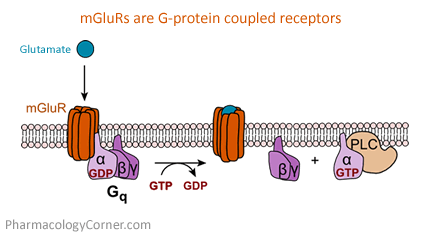
There are eight subtypes of metabotropic glutamate receptors, which are organized into three separate groups (I, II and III).
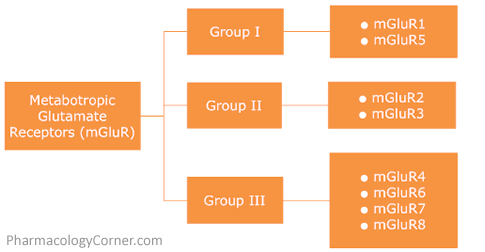
Recent findings suggest that groups II and III might be located presynaptically, where they function as autoreceptors to block glutamate release. Autoreceptors act as “detectors” of glutamate activity in the synaptic cleft. When ligands activate group II and III mGluRs glutamate release may be reduced. Therefore, activation of presynaptic group II and III mGLURs may inhibit glutamatergic excitatory neurotransmission.
Group I metabotropic glutamate receptors may be located postsynaptically, where they hypothetically enhance excitatory glutamatergic neurotransmission.